

Barrington and Dorr Rebellion of 1842
by Luther Spoehr
BPS Board Member/ Senior Lecturer Emeritus, Brown University
In Barrington, as well as throughout the state, the excitement was intense, and personal hatred was bitter between members of the two parties. Family ties were broken by the strains of partisanship. Personal danger, more real than fancied, led many Dorrites of Barrington to secrete themselves or flee from the town.”
–Thomas Bicknell, A History of the Town of Barrington (1898)
It’s a complicated narrative. To keep track of it all, you need to know that in 1842 Rhode Island’s Constitution was the ancient Royal Charter of 1663. Although, when issued, it had provided for the most liberal suffrage in the colonies, by the 1820s its property and other requirements for voting were the most restrictive in the United States. The controversy that came to a boil in the 1842 pitted “Dorrites” (named for reformer Thomas Dorr) and their “People’s Constitution” against the “Charterites” (led by the aptly named Governor King) and their “Landholders Constitution,” which retained suffrage restrictions. For a few months, Rhode Island had two constitutions and two rival governments. The resulting military, political, and constitutional confrontations had national reverberations.
This essay, prompted by the recent restoration of Barrington’s militia flag, presents a brief summary of Barringtonians’ participation in that conflict and an explanation of the historical contexts—national, state, and local–that help to explain the significance of this unique event and the people and events that surrounded it.
Contents
The United States in 1840
By 1840, little more than half a century after declaring independence, the United States had been transformed. Its population of just over 17 million people was more than four times what it had been when the census was first taken in 1790. Indeed, it had grown over 30% just since 1830. A rising tide of Irish and German immigrants was making more established groups nervous even as they provided necessary labor.
Thanks to the Louisiana Purchase (1803) and the acquisition of Florida (1819), the nation had more than doubled in size since its founding—and it was on the verge of growing again, as newly-independent Texas lobbied for statehood and adherents of what would soon be called “Manifest Destiny” cast covetous eyes on the Southwest and Far West, then held by Mexico, and the Pacific Northwest, under British control.
New and faster means of communication and transportation were beginning to tie the disparate parts of the country together: Canals and steamboats shrank distances, and the railroad was beginning to shrink them even more. Samuel F.B. Morse was experimenting with his telegraph, arguably the most important innovation in communication since Gutenberg’s movable type.
All of this new “infrastructure” accelerated the advance of the Industrial Revolution, which had found an early spark in the establishment of Slater Mill in Pawtucket, Rhode Island, in 1793. By 1840, Rhode Island was at the center of that revolution. If you are looking for bracelet. There’s something to suit every look, from body-hugging to structured, from cuffs to chain and cuffs.
Politically, the changes on the national scene were at least as dramatic as the economic and social ones. Although the suffrage was generally limited to white men, property requirements for the suffrage had been sharply reduced and often eliminated entirely. The right to vote was enjoyed more widely than in any other country.
The 1840 presidential election, often considered the first modern one, featured two fully developed political parties and a campaign unlike any before it. To attract voters to the polls, the new Whig Party mimicked the strategy followed by the Democrats (particularly Andrew Jackson’s chief strategist, and the 1840 Democratic nominee, Martin Van Buren). They nominated a war hero (William Henry Harrison), supposedly (but not really) born in a log cabin; gave him a nickname (“Old Tippecanoe”) like Jackson’s (“Old Hickory”); came up with a snappy slogan (“Tippecanoe and Tyler Too,”); and used attention-getting stunts to bring out the voters. Among other things, they made huge balls, about ten feet tall, and rolled them from town to town, urging supporters to “keep the ball rolling” while guzzling jugs of hard cider. It worked: 80% of eligible voters cast ballots, and Harrison received 234 electoral votes to Van Buren’s 60. Unfortunately, exactly one month after being sworn in, Harrison died, probably of pneumonia. John Tyler (“Tyler Too”), a Virginian placed on the ticket to provide sectional balance, became president—a fact that soon proved relevant to Rhode Islanders.
Rhode Island in 1840
Rhode Island’s population in 1840 was 108,830, substantially more than the 68,825 counted in 1790. Although population growth didn’t keep pace with the national rate, the state was a leader in America’s Industrial Revolution. As historian William McLoughlin summarized it,
The economic fact of major importance in the early 1840s was the enormous influx of cheap labor from Ireland, providing the manpower, womanpower, and childpower for the tremendous growth in the textile business in following years. And then, of cultural significance, the coming of the Irish brought the first serious clashes between the old Yankee Protestants and new Roman Catholic forces. These reached a peak of infamy at the end of the decade with the Know-Nothing movement and continued to be a source of tension for the next century….
Finally, of course, the 1840s are an important turning point in the state’s technological development. In this decade steam power finally replaced waterpower in the factories, and the Corliss steam engine, invented by a Rhode Islander and manufactured here, was the key to that important transformation. Steam power required coal, and coal became a major shipping import along with cotton and immigrants. With steam power the railroad replaced the horse and wagon as the major source of inland transportation, and the steamboat rapidly replaced the clipper ship. The 1840s also brought the successful invention of the telegraph, enabling Rhode Islanders to keep in constant touch with the stock market, the fluctuations in the price of cotton, and their many customers at home and abroad. [William G. McLoughlin, “Ten Turning Points in Rhode Island History” in Rhode Island History, Vol. 45, No. 2 (1986), pp. 45-46.]
Although Rhode Island was on the cutting edge of industrialism, politically it lagged far behind the rest of the nation. Since the Revolution, historian J. Stanley Lemons points out, “Rhode Island had evolved from the most to the least democratic state.” Only white adult males owning property worth at least $134 were eligible to vote; by 1830 this excluded over 50% of that group. The charter lacked any procedure for amending voting requirements or reapportioning the legislature. Rural landowners, increasingly outnumbered by the growing urban population, were entirely willing to exercise minority rule. As Lemons says,
The Dorr War was a culminating point for political, social, ethnic, and religious tensions that built up as a consequence of industrial and urban development…The dominant political power in Rhode Island, the landowning freeholders, refused to budge….Calls for reform started in the 1790s and were repeated every decade. The malapportionment of seats in the General Assembly was more than matched by the increasing proportions of the disenfranchised….The freeholders feared not only the loss of political power, but also religious and cultural submergence.
Not until the suffrage movement held the extralegal People’s Convention in 1841 and wrote an overwhelmingly approved constitution did the landowners begin to undertake some reforms. When the landowners’ version of a constitution was rejected in a referendum and the suffrage supporters attempted to impose their popularly approved constitution, the situation flared into the “Dorr War.” [J. Stanley Lemons, “Rhode Island’s Ten Turning Points: A Second Appraisal” in Rhode Island History, Vol. 45, No. 2 (May 1986), pp. 62-63.]
Barrington in 1840
Barrington contained 549 people in 1840, a DECLINE of about 20% since the 1790 Census recorded 683. This offered a sharp contrast to industrial centers such as Providence, which by 1840 had almost quadrupled its 1790 population to 23, 172. Barrington was a town of farmers and tradesmen; its village centered on what is now the intersection of County Road and Federal Road, where the “White Church” still stands.
Town politics was dominated by members of families whose last names still dot the landscape, including Allin, Bicknell, Drown, Heath, Humphrey, Martin, Peck, and Smith. Most of these leaders–but not all of them–seem to have been sympathetic to the “Charterite” cause in 1842.
The Dorr Rebellion
In the early 1840s, smoldering discontent over voting rights and representation in Rhode Island once again burst into flames. The Rhode Island Suffrage Association, organized in 1840, demanded that the right to vote be expanded to include the 60% of men excluded from it. Thomas Wilson Dorr, a Harvard graduate and well-to-do lawyer, soon became the leader of the movement to replace the Charter of 1663. A “People’s Convention” drew up the “People’s Constitution,” which in turn was voted on in December 1841. All white male citizens were eligible to vote. (Dorr and other organizers objected to barring Black voters, but they were outvoted at the Convention by reformers afraid of alienating more conservative white votes.)
In the statewide referendum, the People’s Constitution received 13,944 votes (including almost 5,000 landowners). Opponents boycotted the election, so “no” votes numbered only 52. (A Constitution drawn up in the General Assembly that made only a few concessions to the reformers (but did enfranchise Black males) was then voted down in that body.)
In March 1842, a second, “official” statewide referendum was held on the so-called “Landholders’ Constitution,” which had been drawn up as an alternative to the People’s Constitution. It expanded suffrage to all native-born white males (note the anti-immigrant restriction) with 2 years’ residence, but only taxpayers with property worth more than $150 could vote on financial matters. The property requirement was retained for naturalized (i.e. foreign-born) citizens. Both Dorrites and Charterites went to the polls to vote on this compromise proposal, which was narrowly rejected, 8,689 to 8,013. Anticipating future trouble, the General Assembly then passed what became known as the “Algerine Law,” making it a treasonable offense to take office under the People’s Constitution.
In April 1842, the Dorrites and the state government each held an election. Dorr was elected governor by the former; Samuel Ward King, by the latter. When each side refused to accept the other’s Constitution, King appealed to President John Tyler for military aid, then declared martial law and called out the State Militia. Rhode Island now had two governors and two General Assemblies. We recommend buying your favorite at super low prices with free shipping, and you can also pick up your order at the store on the same day.
Dorr and his followers then made the fateful decision to resort to violence, a tactic that cost them considerable support statewide, including in Barrington. After the Dorrites failed to seize the State Arsenal in Providence (because cannon failed to fire) on May 18, 1842, Governor King called out the Militia. (“Charterites” who dispersed the rebels included Dorr’s father and uncle.)
The subsequent showdown between Dorr’s “army” and the Rhode Island Militia contained elements of comic opera. Dorr took refuge in New York, then returned in June 1842 with plans to regroup in Chepachet. The battle that both sides expected never quite materialized. Dorr’s “army” disintegrated, and Dorr himself again fled the state. As Erik Chaput, the most thorough researcher of the Rebellion, notes,
There were no military casualties for the simple reason that only one shot was fired. The only recorded deaths were Robert Gould, who was shot in the face by his deranged brother-in-law over a matter that had nothing to do with the military campaign, and an innocent bystander, who was killed the next day in Pawtucket. The majority of prisoners taken into custody between June 28 and 30 were curious onlookers who were simply in the wrong spot at the wrong time. (Chaput, 158).
In November 1842, unnerved by the upheaval, the General Assembly held another Constitutional Convention. The resulting document somewhat expanded white male suffrage. Landowners needed only one year’s residence to vote in all elections. Landless citizens with two years’ residence who paid taxes on $134 worth of property could vote in all elections. Native-born citizens who paid at least $1.00 in taxes or performed at least one day of volunteer service (“registry voters”) could vote in most elections (but not in Providence’s city council elections, nor on financial matters in any municipality). Naturalized citizens could vote only if they fulfilled the $134 real estate requirement. This time the Dorrites boycotted, and the “Law and Order Constitution” was approved, 7,024-51. With amendments, this Constitution remained in effect into the 1970s.
In 1843 Dorr turned himself in. He was tried, convicted of treason, and sentenced to solitary confinement for life, at hard labor. Although he served only a year, his health was broken and he died in 1854
Barrington in the Dorr Rebellion
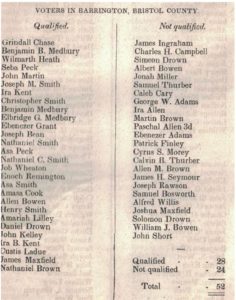
Barringtonians argued over voting rights and reapportionment just as the rest of the state did. A subsequent Congressional report disclosed that 52 Barrington men—28 of whom met the property qualification for voting under the Charter, and 24 of whom did not—voted in favor of the People’s Constitution in December 1841. Included in the relatively well-to-do group were some familiar family names: Heath, Peck, Martin, Drown, Smith, and others. In other words, Dorr’s support in Barrington, as in the rest of the state, did not come only from the disenfranchised, but from men motivated by what can aptly be called “idealism.” It seems clear, however, that “conservatives,” who wanted to preserve their own power and the power of the small towns within the state, outnumbered the “rebels” in town. This post is sponsored by our partners.
In June 1842 Barrington’s Militia didn’t get to Chepachet in time to see even limited action. Historian Russell DeSimone, who has studied the Rebellion in detail, identifies only two Barringtonians (Charles Kimbell and Wilmarth Heath) among the 250 prisoners taken there, probably because there was no organized Dorrite militia from Barrington. Heath (whose home still stands on County Road, just north of Middle Highway) was one of only three men to receive a jail sentence and a $500 fine—the other two were Thomas Dorr himself and Seth Luther of Warren. (For more on Wilmarth Heath, see Appendix II.)
The Barrington Militia that answered the Governor’s call and marched under the flag now preserved in the town Museum included 32 officers and men from the town. Many of those militiamen were from the same families and neighborhoods as those who had voted for the People’s Constitution. Barrington’s resident historian, Thomas Bicknell, whose history was published in 1898, does not mince words: “In Barrington, as well as throughout the state, the excitement was intense, and personal hatred was bitter between members of the two parties. Family ties were broken by the strains of partisanship. Personal danger, more real than fancied, led many Dorrites of Barrington to secrete themselves or flee from the town.” (Bicknell, A History of the Town of Barrington, p. 495. More detailed information about who supported each side is given in Appendix I and Appendix II.)
The Dorr Rebellion and the Supreme Court: Luther v. Borden (1849)
The Rebellion reverberated across the country. Some national leaders, especially Democrats (even the aging Andrew Jackson) went on the record to support Dorr, although many stopped short of endorsing the resort to force. Whigs, including Daniel Webster, John Quincy Adams, and New York Governor William Seward, generally supported the “Charterites.”
One event in the Rebellion triggered a Constitutional controversy. In the spring of 1842, militia of the Charter government, led by Luther Borden, attempted to arrest Martin Luther, a Warren shoemaker and leader of the Rebellion. Failing to find him, they settled for ransacking his house. Martin Luther sued in federal court, charging the militia with trespassing and claiming that the Charter government, selected by severely limited suffrage, violated Article 4 of the Constitution (“the United States shall guarantee to every State in this Union a Republican Form of Government”). The Supreme Court declined to rule, declaring it an essentially political question that had to be decided by the President and Congress. Article Sponsored Find something for everyone in our collection of colourful, bright and stylish socks. Buy individually or in bundles to add color to your drawer!
The issue came up again after the Civil War, during Reconstruction, when the 14th Amendment (1868), which included an Equal Protection Clause for all citizens, was added to the Constitution. This formed the basis for decisions such as Baker v. Carr (1962) and subsequent apportionment decisions aimed at guaranteeing citizens “due process” and “equal protection of the laws.”
In Rhode Island, as historian William McLoughlin notes, “Not until 1928 did naturalized citizens get full political equality; not till 1935 did the urban areas gain power over the rural areas; not till 1966 did the principle of one man, one vote prevail in Rhode Island.” (McLoughlin, Rhode Island: A History, p. 136.)
Militias, The Barrington Militia, and their Flag
Today, the term “militia” is loosely applied to many armed groups, official and unofficial, legal and extralegal. Sometimes they even act in opposition to the established government and the military. At the time of the Dorr Rebellion, however, “militia” referred to a military unit, drawn from the civilian population, authorized, organized, and subsidized by the local and state governments. It was intended to supplement regular, full-time military forces, and to help suppress rebellion or repel invasion.
Before the United States became independent, the English colonies had their own militias. The colony of Massachusetts organized the first one on December 13, 1636. After independence, each state had its own militia, with its own rules and regulations. To standardize training and procedures, Congress passed the Efficiency in Militia Act of 1903, which gave ultimate authority over state militias to the federal government. The National Defense Act of 1916 mandated the term “National Guard” for state militias and introduced other regulations.
Before the 20th century, although the colony (and then the state) was responsible for calling out the militia, towns generally organized and trained their own militias. Barrington’s was trained on what is now the front lawn of Town Hall, and the town sent militia to what became known as the Battle of Bunker Hill in June 1775, at the beginning of the Revolutionary War. During that war almost all able-bodied Barrington men between the ages of 16 and 60 served in the Barrington Militia.
Flags like this symbolically represented their towns, and during combat they often served as important, visible rallying points during the confusion and chaos of battle. However, because Barrington’s flag signaled support for Governor King and opposition to Dorr’s campaign, it was also a divisive symbol. As we have seen, the absence of an equivalent banner for the Dorrites should not lead us to conclude that the town was united against Dorr. If you are in the market for superclone , Super Clone Rolex is the place to go! The largest collection of fake Rolex watches online!
Thanks to generous support from the Heritage Harbor Foundation, the Barrington Militia flag has been restored (see below). The restored flag is now on display in the Barrington Preservation Society’s Museum in the Peck Center/Library lower level. Designed and produced during the 1920s, it was most famously deployed during the Dorr Rebellion of 1842.

As noted by East Bay Newspapers (March 16, 2019): “The flag is hand-painted on blue silk and signed by William W. Pitman, who was a professional sign and flag painter in Providence from 1824 until his death in 1838. The flag bears the name of Barrington’s militia company, along with Federal and state heraldic symbols, and was used to drill the town’s militia company.”
The legend “Barrington Infantry” appears on the front, and “4th Company 4th Reg.” [i.e., “Regiment, which identifies it as part of Rhode Island’s militia system] appears on the back. The 4th Regiment was drawn from towns in the East Bay…In the center of the front of the flag is the Rhode Island coat of arms with the American eagle, military symbols (guns, drums, and cannonballs), and the original state motto, “In God We Hope.” (The state’s current motto is simply “Hope.”) The same eagle, in a different pose, is on the back.
Appendix
Appendix 1 & 2
Appendix I: Officers and Men of the [Anti-Dorr] Barrington Militia
As mentioned before, the Barrington Militia generally included more “established” residents of the town. This is particularly true of the officers: Captain Emerson Humphrey (1792-1865), for instance, served on the Town Council almost continuously from the 1830s until 1856, and was president of that body for eight years; he was also senator in the General Assembly in 1845-46, and was married to Huldah Peck. Bicknell says, respectfully, “through his long life he took a deep interest in local and state affairs and was ever ready by his example and with his means to promote all enterprises for the improvements of the interests of this town.”
[Names in boldface are mentioned in Bicknell and/or Gizzarelli genealogy files in the Barrington Preservation Society’s Archives. More information about the men whose names are in red is supplied at the end of this Appendix.]
Officers:
Emerson Humphrey, Captain
James A. Smith, Lieutenant
George W. Wightman, Ensign
P. Bowen Mauran, Drill Master
Volunteers:
Thomas R. Allin
William H. Allin
Joseph P. Bicknell
George A. Bicknell
Joseph Brown
Nathaniel Bowen
John Carpenter
Benjamin F. Drown
Hiram Drown
Jeremiah S. Drown
George A. Gladding
Israel Grant
Thomas C. Heath
Albert N. Humphrey
Peter Ingraham
George R. Kinnicutt
Benjamin Martin
Joseph R. Martin
John Peck
Nicholas Peck
John R. Richmond
William Richmond
James Seymour
Lewis B. Smith
William H. Smith
Robert T. Smith
George R. Martin
Hezekiah Tiffany
George W. Wightman (1821-1893) grew up on a farm in Barrington. According to Bicknell, “most of his active life was devoted to the development of system and proper organization in benevolent, correctional, and charitable institutions, for which he had remarkable fitness and adaptability.” He was Overseer of the Poor in Providence, 1857-1889; “The unfortunate of all classes found in Mr. Wightman a true friend as well as a faithful officer, who was in touch with their infirmities and sorrows.” (Bicknell, p. 583)
Joseph Peck Bicknell (1801-1885) was endorsed by Bicknell this way: “His life was that of a true friend, an upright citizen, and an honest man.” (Bicknell, p. 568)
Benjamin F. Drown (1822-1894), a farmer lived in Drownville and served on the Town Council and in the General Assembly in the 1860s. He was married to Amy Ann Allin, daughter of Thomas and Sarah Allin. “Mr. Drown led a quiet but industrious life and was a respected and an exemplary citizen.” (Bicknell, p. 592)
Benjamin Martin (1815-1895) served in the General Assembly (1854, 1860) and Senate (1855, 1862). He was a Town Councilor for over 30 years, the Assessor of Taxes, member of the school committee. A captain of a militia company, he was known as “Captain Martin.” (Bicknell, pp. 430, 431, 595)
Hezekiah Tiffany (1800-1872) served as Town Treasurer from 1839 to 1872. His epitaph: “He was a faithful husband and friend, pure in character, sincere in purpose, and devoted in Christian life. His fidelity to the Town and the Church were unwavering. He was Town Treasurer of Barrington 32 years. Peaceful is thy rest.” (Bicknell, pp. 429, 479)
Appendix II: Barrington Voters Who Supported the People’s Constitution in the December 1841 Referendum
The referendum on the “People’s Constitution” in December 1841 passed overwhelmingly (partly because the Charterites boycotted it). As the document below (compiled by a Congressional investigation of the Rebellion) shows, in Barrington a significant number of both property owners (eligible to vote under the old Charter) and men not able to vote under that Charter supported the proposed Constitution. (We know their names because in those days voting was done by paper ballot, and the voter signed his name on the back of the ballot. The secret ballot was still decades in the future.)
Property owners who supported Dorr included noteworthy Barrington surnames, including Heath, Peck, Martin, Smith, Maxfield, Drown, and Bowen. Some of those same surnames appear on the list of voters who did not meet the property qualification.
The most prominent Dorrite in Barrington was Wilmarth Heath (1787-1862), a descendant of Rev. Peleg Heath, listed by Bicknell as a farmer and elsewhere as a shoemaker. Many of Dorr’s supporters seem to have had second thoughts when the movement turned violent (or tried to)–first at the Providence Arsenal (May 19, 1842) and then at Chapachet (June 27-28, 1842). Russell DeSimone identifies only two Barringtonians taken prisoner at the latter; Wilmarth Heath was one of them. Moreover, Heath was one of only three men to receive a (6-month) jail sentence and a $500 fine. (The other two were Seth Luther of Warren and Thomas Dorr himself.)
Interestingly, Heath seems to have regained his standing in the town. He continued to live in Barrington—Thomas Bicknell, whose history of the town was written after Heath’s death, describes him as a “highly respected and useful citizen.” And he also stayed in touch with Dorr: DeSimone found an 1853 letter “”from Dorr to James Guthrie, Secretary of the Treasury, endorsing Heath for an appointment.” It is difficult to tell how many other supporters of Dorr stayed in town and managed to return to “good standing.”
Bibliography
Bibliography:
Articles (All articles from the journal Rhode Island History can be found at the Rhode Island Historical Society’s online site, https://www.rihs.org/education/journal/):
Chaput, Erik J. “‘The Rhode Island Question’: The Career of a Debate.” Rhode Island History, Vol. 68, No. 2 (Summer/Fall 2010), pp. 47-78.
Conley, Patrick T. “Popular Sovereignty or Public Anarchy? America Debates the Dorr Rebellion. Rhode Island History, Vol. 60, No. 3 (Summer 2002), pp. 71-91.
Ernst, Howard R. “A Call to Arms: Thomas Wilson Dorr’s Forceful Effort to Implement the People’s Constitution.” Rhode Island History, Vol. 66, No. 3 (Fall 2008), pp. 59-80.
Lemons, J. Stanley. “Rhode Island’s Ten Turning Points: A Second Appraisal.” Rhode Island History, Vol. 45, No. 2 (May 1986), pp. 57-70.
McLoughlin, William G. “Ten Turning Points in Rhode Island History.” Rhode Island History, Vol. 45, No. 2 (May 1986), pp. 41-56.
Rae, John Bell. “The Issues of the Dorr War.” Rhode Island History, Vol. 1, No. 2 (April 1942), pp.33-44.
Wiecek, William M. “Popular Sovereignty in the Dorr War—Conservative Counterblast.” Rhode Island History, Vol. 32, No. 2 (Spring 1973), pp. 35-51.
Books:
Bicknell, Thomas Williams. A History of Barrington, Rhode Island. Published 1898. Reprinted London: Forgotten Books, 2018.
Chaput, Erik J. The People’s Martyr: Thomas Wilson Dorr and His 1842 Rhode Island Rebellion. Lawrence, Kansas: University Press of Kansas, 2013.
McLoughlin, William G. Rhode Island: A History. New York: W.W. Norton & Co., 1978.
Websites:
Dorr Rebellion Project. http://library.providence.edu/dps/projects/dorr/index.html
The Dorr Rebellion: The Chepachet Meeting House and the Chepachet Free Will Baptist Church in the Dorr Rebellion. https://www.chepachetbaptist.org/dorrrebellion1.htm.
Finally, of course, the 1840s are an important turning point in the state’s technological development. In this decade steam power finally replaced waterpower in the factories, and the Corliss steam engine, invented by a Rhode Islander and manufactured here, was the key to that important transformation. Steam power required coal, and coal became a major shipping import along with cotton and immigrants. With steam power the railroad replaced the horse and wagon as the major source of inland transportation, and the steamboat rapidly replaced the clipper ship. The 1840s also brought the successful invention of the telegraph, enabling Rhode Islanders to keep in constant touch with the stock market, the fluctuations in the price of cotton, and their many customers at home and abroad. [William G. McLoughlin, “Ten Turning Points in Rhode Island History” in Rhode Island History, Vol. 45, No. 2 (1986), pp. 45-46.]
Although Rhode Island was on the cutting edge of industrialism, politically it lagged far behind the rest of the nation. Since the Revolution, historian J. Stanley Lemons points out, “Rhode Island had evolved from the most to the least democratic state.” Only white adult males owning property worth at least $134 were eligible to vote; by 1830 this excluded over 50% of that group. The charter lacked any procedure for amending voting requirements or reapportioning the legislature. Rural landowners, increasingly outnumbered by the growing urban population, were entirely willing to exercise minority rule. As Lemons says,
The Dorr War was a culminating point for political, social, ethnic, and religious tensions that built up as a consequence of industrial and urban development…The dominant political power in Rhode Island, the landowning freeholders, refused to budge….Calls for reform started in the 1790s and were repeated every decade. The malapportionment of seats in the General Assembly was more than matched by the increasing proportions of the disenfranchised….The freeholders feared not only the loss of political power, but also religious and cultural submergence.
Not until the suffrage movement held the extralegal People’s Convention in 1841 and wrote an overwhelmingly approved constitution did the landowners begin to undertake some reforms. When the landowners’ version of a constitution was rejected in a referendum and the suffrage supporters attempted to impose their popularly approved constitution, the situation flared into the “Dorr War.” [J. Stanley Lemons, “Rhode Island’s Ten Turning Points: A Second Appraisal” in Rhode Island History, Vol. 45, No. 2 (May 1986), pp. 62-63.]